

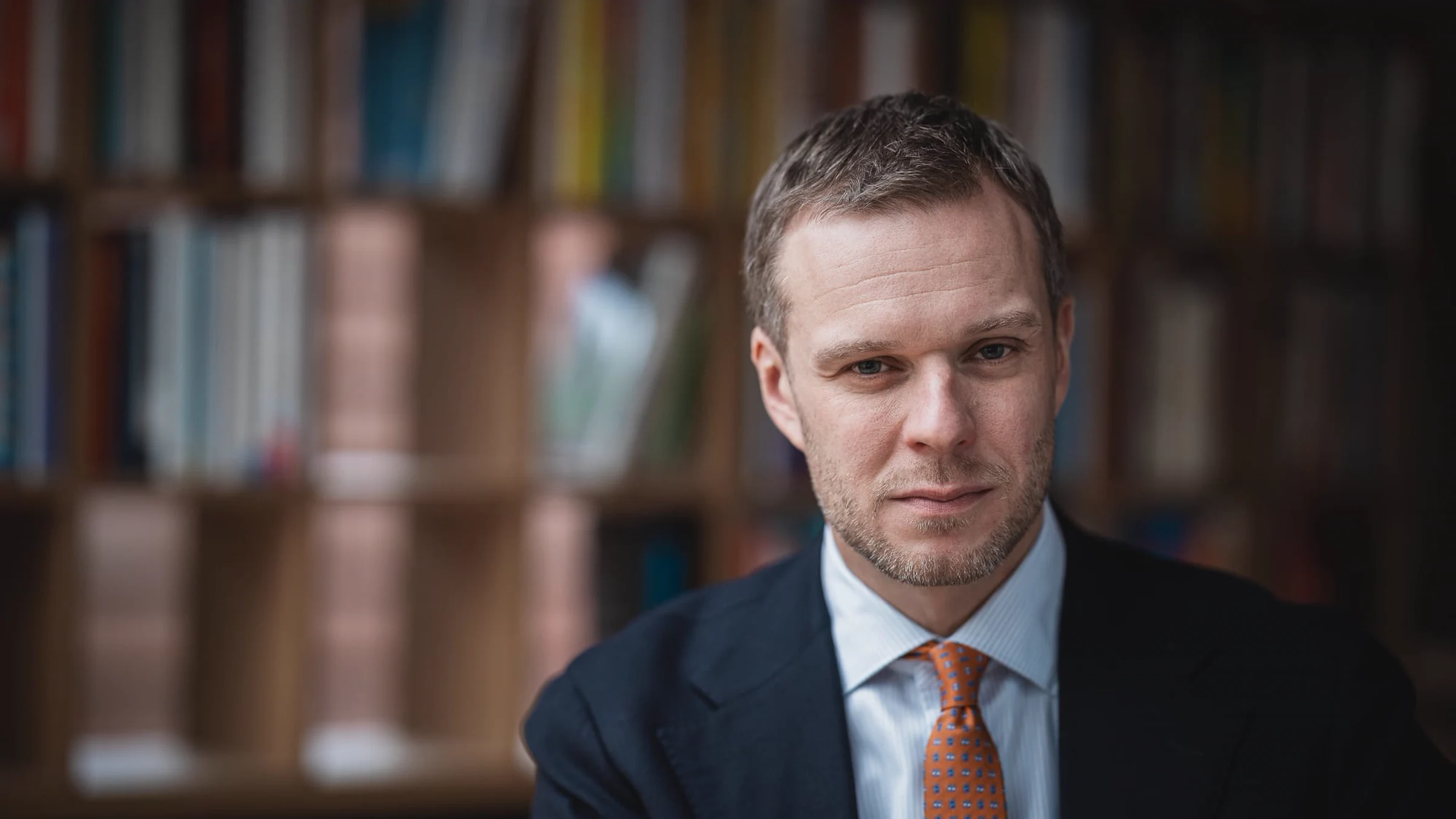
Gabrielius Landsbergis
When Gabrielius Landsbergis accepted France’s Legion of Honour in September 2026, his grandfather Vytautas was in the room. In March 1990, Vytautas chaired the parliamentary session at which Lithuania declared the restoration of its independence. In his acceptance speech, Gabrielius said that because Lithuanians had lived through the restoration of their own independence, they recognised the same desire for freedom in others. That was how he explained Lithuania’s support for Ukraine, Belarusian civil society and Taiwan.
He studied history and international relations in Vilnius and worked as a diplomat in Brussels before entering politics. As a member of the European Parliament, he led work on its 2015 report on relations with Russia after the annexation of Crimea. He served as Lithuania’s foreign minister from 2020 to 2024. During his tenure, Vilnius hosted a NATO summit and a Taiwanese representative office opened in the city. Landsbergis also signed an agreement with the Council of Europe to set up an information point for Belarusians. It opened in Lithuania’s National Library in May 2026.
He is now a visiting fellow at Stanford University. On 10 November 2026 he gave evidence to the British House of Commons Foreign Affairs Committee. He also writes a newsletter under his own name.
Kryštof Peterka asks the questions. Gabrielius Landsbergis answers.
Taiwan’s office in Vilnius
Taiwan opened its office in Vilnius in 2021 as the Taiwanese Representative Office in Lithuania. Beijing saw the name as a challenge to its claim over Taiwan and downgraded diplomatic ties with Lithuania. In a bid to improve ties, Lithuanian politicians have discussed renaming it the Taipei Representative Office, after Taiwan’s capital.
Should Lithuania try to improve ties with China while keeping the office’s current name?
Well, the question is why Lithuania needs better relations with China. That is probably the main question that needs to be answered. When government officials say it’s because everybody else has them, it’s worth asking whether that is really something we should copy.
When Iceland recognised Lithuania’s independence ahead of everybody else in 1991, about half a year before everybody else, it stood apart. It was the first, and for a time the only one. As Lithuanians, we still remember that. We cherish it and we celebrate it. Sometimes it is important to step outside the crowd. Others may be unable to do what you can do.
It is also more important than ever to understand the broader geopolitical picture when you ask yourself this question. China is firmly behind Russia, supporting Russia’s war against Ukraine. So when people say we need a better relationship with China, I really don’t understand how they explain that to themselves.
Lithuania on NATO’s border with Kaliningrad and Belarus
Lithuania borders Belarus and Russia’s Kaliningrad region. What might surprise someone in Prague about life near those borders?
Many people are surprised when they look at the map and see that Russia has this island of territory in Europe, a legacy of the settlement after the Second World War. The territory was German, and it was left to the Russians. Over the years, it has basically been turned into an enormous military base. It houses Russian troops, air defences and cyber units. When Czech people read about GPS jamming, about planes suddenly losing their satellite navigation, the jamming is very likely coming from Kaliningrad. It can house nuclear weapons. I wouldn’t be surprised if it already did.
So think about Lithuania. On one side we have Kaliningrad. On the other we have what I would call another Russian military territory, Belarus, with Russian troops training there and potentially nuclear weapons there as well. You could call it being between a rock and a hard place. Thankfully, we are part of NATO. Its troops, including Czech troops, help defend Lithuania. We are grateful to Czechia for that decision. We still hope that we are doing enough to help Ukraine and to defend ourselves, so that Russia will not want to try occupying us again.
What to say when the air alert goes out
Lithuania briefly restricted flights at Vilnius and Kaunas airports during air alerts on 10 November. What should the government tell people before it knows what triggered the alert?
We have two kinds of threats in Lithuania. One is balloons and the other is drones. We believe most of the balloons are used to smuggle cigarettes, drugs and other things from Belarus. What might be interesting to your readers is that Vilnius is only 30 kilometres from the Belarusian border. The airport is so close to the border that when those balloons come over, it has to shut down.
We think this is a form of hybrid activity. It is hard to imagine this happening without the Belarusian government’s knowledge. Who knows, it may even be involved. I see a parallel with migrants being pushed towards the Lithuanian border with the Belarusian government’s help.
Then there are drones. We have seen more of these incidents over the past year. I’d say it happens every few weeks or at least once a month. A stray drone, either Ukrainian or Russian, enters Lithuanian territory. Balloons and drones are different things, but both can shut down an airport. The drones worry me more, because you never know if one is the beginning of something bigger.
Some nights, hundreds of drones fly into Ukraine. According to Ukrainian government reports, Ukraine takes down most of them. In Lithuania, a single air alert can send the whole country into a panic. How can we learn faster from Ukraine so that these drones pose less of a threat to us?
It’s the government’s responsibility to tell people that there is something in the air and that there is a danger. In that sense, I think they are doing what they have to do. I would like our government and others in the region to be able to add this message. “Don’t worry. We have it under control.”
Security guarantees for Ukraine after a ceasefire
The Abu Dhabi talks covered security guarantees for Ukraine. If Europe promises to protect Ukraine after a ceasefire, what should it put in writing?
First of all, European nations have to promise that they can finance Ukraine’s defence. The money is running out, and that’s a major problem. That’s why I believe Europe has a rather weak hand in the negotiations. Putin sees that Europe has financed Ukraine up to now. If we cannot find a way to keep doing that, especially with elections coming up in Europe, in France for example, we won’t have much say. Money is number one.
The second thing is troops. There should be troops assigned to help Ukraine defend itself. I think President Macron started this conversation back in 2023 or 2024, and I really think we should continue it. I’m sorry it has slipped down the agenda. We should be talking about it more. If Ukraine is left on its own after the ceasefire, which I hope will come one day, it will only set the stage for the next phase of the war.
Finland and NATO
What do you make of the report that Russia is demanding Finland’s withdrawal from NATO in the peace talks?
Editor’s note. The German newspaper Bild reported the alleged demand on 13 November. The Kremlin denied the report. Finland joined NATO in April 2023.
It’s not surprising at all. It’s pretty clear that Putin’s demands haven’t changed since 2021, maybe even earlier. He believes he can rearrange Europe to suit his view of it.
What might be surprising is that the Finnish president has been leading efforts to reach out to Putin and talk to him. He was the one who called, together with the Norwegian prime minister. And now, to add this as a demand would be an affront to the Finnish people.
But it’s a good reminder, honestly, of who Putin is and how we should deal with him. If anyone thinks we can bring Putin a bouquet of flowers and somehow change his opinion of us, that’s nonsense. With people like that, forgive my language, you smack them in the face and then you might have a conversation.
Editor’s note. Finnish President Alexander Stubb and Norwegian Prime Minister Jonas Gahr Støre spoke to Vladimir Putin on 27 October 2026.
The NATO mission in Lithuania and Czech security
How does the Czech contribution to NATO’s mission in Lithuania help keep Czechia safe?
I believe we all understand that we are connected in NATO and in Europe. The security of European countries is indivisible. If Lithuania isn’t safe, Czechia cannot be safe. Being able to protect countries closer to the front line makes you safer. That’s what collective security is about.
Unfortunately, that understanding isn’t always shared in Europe. People still think Ukrainian soldiers are fighting for the Donbas, or for pride, or for recognition, I don’t know what. In my view Ukrainians are fighting for Lithuania as much as they are fighting for Czechia. In the same way, Czech soldiers in Lithuania are there to defend Czechia.
I remember that during my time as minister, Andrej Babiš questioned whether Czechia would send troops to defend the Baltic states. I said then that we might not know whether Czech soldiers would be sent to defend Lithuania, but I could tell you that Lithuanian soldiers would be sent to defend Czechia. That was my promise, our pledge. It goes without saying.
From what I read coming from the Czech government, its position seems fairly clear. When we talk about solidarity, we value it. It matters to us. That politician speaks a little differently now.
Editor’s note. In Czech Television’s presidential debate on 22 January 2023, candidate Andrej Babiš, then an MP and leader of the opposition ANO party, said he would not send Czech troops to help Poland or the Baltic states if they were attacked. Later that evening he said that in the event of an actual attack he would honour Article 5 of the North Atlantic Treaty, which sets out the principle of NATO’s collective defence.
What smaller countries bring to the table
As foreign minister, how did you help European allies agree on a response to Russia?
It’s a constant job. You bring the point of view of a smaller country on the front line and help your allies understand what’s at stake. Especially when you come from a country that fought Russia, was occupied by Russia, very much wants to avoid being occupied again and believes it could still happen.
There is a historical, even cultural, understanding of what is happening and why it matters. It isn’t always easy to persuade people and build a consensus. But without the voice of the Baltic states and countries on the eastern flank, it would be a different debate. It would be easier for our allies, for the West, to look away from what’s happening in Ukraine.
The first 72 hours of a crisis
Both Czechia and Lithuania advise people on the first 72 hours of an emergency. What can Czechia learn from Lithuania’s experience?
In Lithuania we’ve taken the first steps, though I wouldn’t say we’ve got very far. The biggest issue, I think, is that people put a great deal of hope in what the government will do for them in a crisis. It could be a war, a natural disaster or another kind of emergency. I think part of that comes from our Soviet occupation. The state was so all-encompassing that we expected it to do everything. It also comes from a promise governments have been wrong to make. We’ll take care of it.
In the first 72 hours, the authorities won’t be able to look after everyone. When researchers ask whether people have enough water at home for three days if the supply is cut off, very few say they do. People expect the authorities to bring in water tankers.
I think it’s important to talk about this in my country, and I’m pretty sure it is in Czechia too. I know it’s also an issue in the other Baltic countries. We need to get the message across that the government will help those who are unable to help themselves. If you’re healthy and able, you have to think about how you’ll get through those first 72 hours. You have to be ready. That’s where non-governmental organisations, associations and even churches can do a lot to help people prepare.
When Prague and Vilnius speak together
Czech President Petr Pavel visited Vilnius in March. How could Czechia and Lithuania help each other if a larger country, such as Russia, used trade to put political pressure on either of them?
When I was a minister, we worked very closely with the Czech government. I would have called Czechia a very like-minded country. You see the biggest benefit in organisations like NATO and the European Union. The Czech voice is an important one. People listen to it. If we coordinate and support one another, even if it is just the two of us, we’re heard more clearly.
Now imagine what happens if we bring together a group of countries that see an issue the same way. That’s a good way for countries of our size to make more of the influence we have and make ourselves heard. I would look at building those coalitions. And when we fall out of step because governments with different values or interests get elected and we no longer speak with the same voice, you feel it immediately. You feel as if a friend has gone missing.
Young people who want to serve
Lithuania plans to wait until 2032 to introduce universal conscription for young men. What do you make of that decision?
In Lithuania we have more volunteers than the military is ready to take. I find that mind-boggling. You have people who want to serve and you tell them they can’t. It’s just stupid. You’re asking how to persuade young people to join the military. Well, we did. They’re lining up. They want to defend their country, and we’re saying no.
Then it goes to the politicians, they talk about it, and it gets postponed for, I don’t know, the seventh time. Lithuania’s State Defence Council has postponed it until 2032. Maybe Putin will be dead by then and we won’t need to do anything. Right now is the most dangerous time. Right now is when we need to prepare for what could happen, including a possible Russian attack. And more importantly, we have young people who want to do their duty. I think it was a disastrous decision. I’m really unhappy it was made.
Further reading
- Russia’s ambassador in Prague defends the invasion (in Czech)
- Why Garry Kasparov wants Russia to lose the war (in Czech)
- Trump promised peace in Ukraine in 24 hours (in Czech)
Sources and research
- Landsbergis’s Legion of Honour acceptance speech
- Gabrielius Landsbergis in the Lithuanian parliament’s archive
- European Parliament report on relations with Russia
- The NATO summit in Vilnius in July 2023
- Council of Europe on the signing of the agreement for the Belarusian information point
- Opening of the Belarusian information point at Lithuania’s National Library
- Landsbergis’s profile at Stanford University
- Landsbergis before the UK House of Commons Foreign Affairs Committee
- Landsbergis’s newsletter
- Taiwan’s Ministry of Foreign Affairs on its Vilnius representative office
- Lithuania’s foreign ministry on Iceland’s recognition of Lithuanian independence
- Lithuania’s foreign ministry on Moldova’s recognition of Lithuanian independence
- Lithuanian Airports speaking to LRT about restrictions in Vilnius and Kaunas
- Abu Dhabi statement by European partners, Ukraine, the US and NATO
- Bild on Russia’s alleged demand for Finland to leave NATO
- Interfax quotes the Kremlin’s denial concerning Finland and NATO
- How Finland joined NATO
- Finnish presidency on Stubb and Støre’s call with Putin
- NATO on Czechia’s participation in Lithuania
- Czech Television’s transcript of the January 2023 presidential debate
- Czech Radio’s record of Babiš’s clarification after the debate
- Article 5 and NATO collective defence
- The Czech government’s 72-hour preparedness guidance
- Lithuania’s LT72 civil preparedness portal
- Prague Castle on President Pavel’s March visit to Lithuania
- Lithuania’s president speaking to LRT about the date for universal conscription
- Original portraits by Mindaugas Mikulėnas
- Portrait licence. CC BY-SA 4.0. The lead portrait has been cropped.
- China’s foreign ministry on downgrading ties with Lithuania
- Lithuania’s prime minister speaking to LRT about the proposed Taipei name
- Andrej Babiš in the Chamber of Deputies register for 2021–2025
- ANO’s national congress in February 2022